

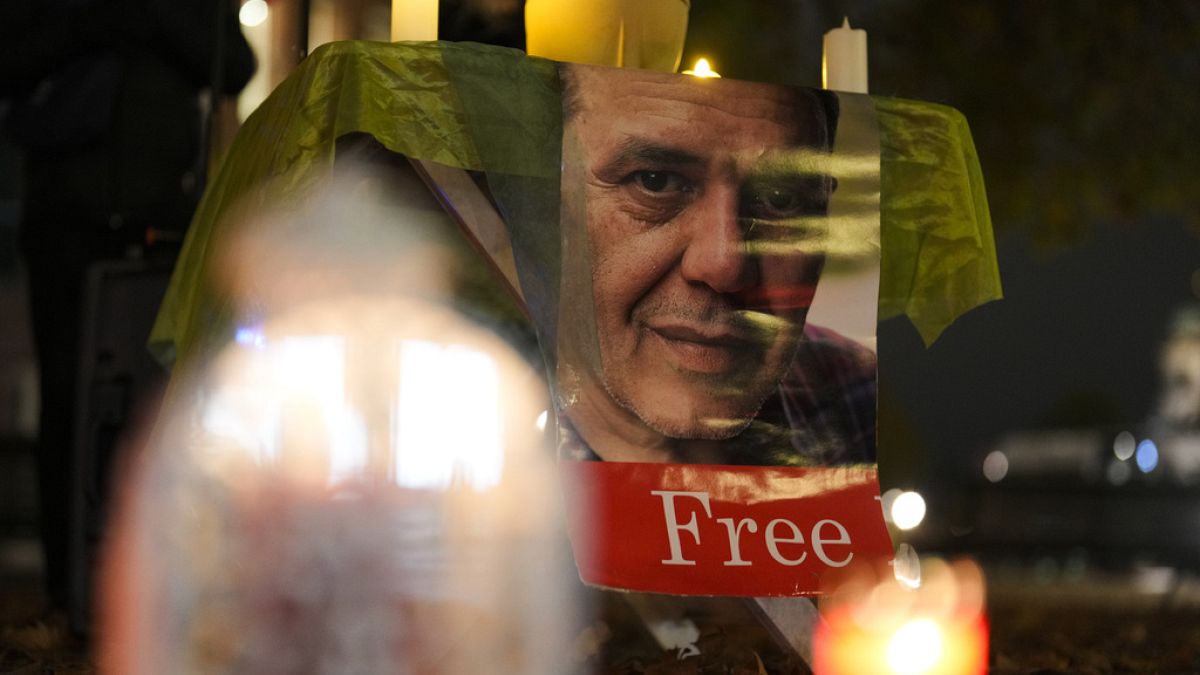
A crowd of demonstrators took to the streets in front of the German Foreign Ministry in Berlin on Monday following the execution of German-Iranian Jamshid Sharmahd, who had spent four years in an Iranian prison on terror charges.
The 69-year-old was born in Tehran but spent his childhood in Germany, then moved to Los Angeles in the early 2000s and was eventually granted US residency.
A software engineer, Sharmahd had been campaigning for the Iranian opposition for years when Iranian security forces kidnapped him during a layover in 2020. Iran accused him of plotting a terrorist attack, as well as “disclosing classified information”. He was eventually sentenced to death in 2023, after spending months in solitary confinement.
His daughter, Gazelle Sharmahd, had repeatedly campaigned for his release, including by lobbying the German government. She reported he was faring very badly in solitary confinement, and openly criticised both Germany and the US for failing him.
- Iran’s supreme leader treads carefully in his response to Israel’s latest attack
- Russia and Iran may fuel violent protests after US elections, intelligence officials say
In an article for Die Tageszeitung, journalist Gilda Sahebi criticised the German government for leaving Gazelle Sharmahd alone in her fight.
“When it comes to the Iranian regime, the German government is a supporter of ‘quiet diplomacy'”, she wrote, “probably the worst way to deal with a dictatorial state like the Islamic Republic.”
She added that the German government “did not even dare” to call Jamshid Sharmahd a political hostage — a stark contrast to other countries such as France, Denmark and Austria, who have previously been able to free citizens who they called “state hostages.”
‘We have worked tirelessly’
German Foreign Minister Annalena Baerbock wrote on X that she condemned the murder by the Iranian regime “in the strongest possible terms”.
“I extend all my sympathy to his family for this terrible loss,” she wrote. “We have worked tirelessly on behalf of Jamshid Sharmahd and sent a high-level AA team to Tehran on several occasions. We have repeatedly made it unmistakably clear to Tehran that the execution of a German national will have serious consequences.”
CDU leader Friedrich Merz took up Sharmahd’s cause years ago. He condemned the execution as a “heinous crime” and called on the German government to expel the Iranian ambassador from Berlin.
According to reports from human rights groups, more than 500 people have already been sentenced to death and executed in Iran in the first 10 months of 2024.